The activation gap: a 5-question framework to turn data into growth

Organizations across sectors have more data today than they've ever had, and most still face the same question from leadership: where's the growth? That gap is not a data problem. It is a strategic one – and it sits in a specific place, at a specific moment, that most organizations have never named.
Call it the activation gap: the last stretch where analytics turns into action, and where value is won or lost. It is the point where a well-run data program either compounds into a competitive advantage or quietly stalls into overhead. Getting across it, deliberately and repeatedly, is becoming one of the clearer differentiators between companies that grow and companies that just report.
An insight that doesn't change what a team does isn't valuable yet. It's a chart. And right now, a lot of organizations are investing more than ever to produce very good charts.
Why the mile is where growth actually stalls
Martech and data budgets keep growing, but revenue doesn't scale with them automatically. Most organizations rush to activate before they've resolved three structural gaps, and those gaps compound over time rather than resolve on their own.
Fragmented journeys – customers hit disconnected touchpoints because no one has mapped the data to a single journey.
Disconnected tools – each team buys its own stack, so insight never travels to where the action actually happens.
Untapped potential – the data exists, full of signal, and drives no decision at all.
None of these are tooling problems. They are sequencing problems – the result of activating before answering what the activation is actually for. That's the strategic case for a framework rather than another point solution.
A framework, not another tool
The instinct when growth stalls is to buy another platform and activate faster. It backfires more often than it works, because speed without direction just moves the guesswork downstream. The more durable move is stepping back and answering five questions, in order, before touching the stack:
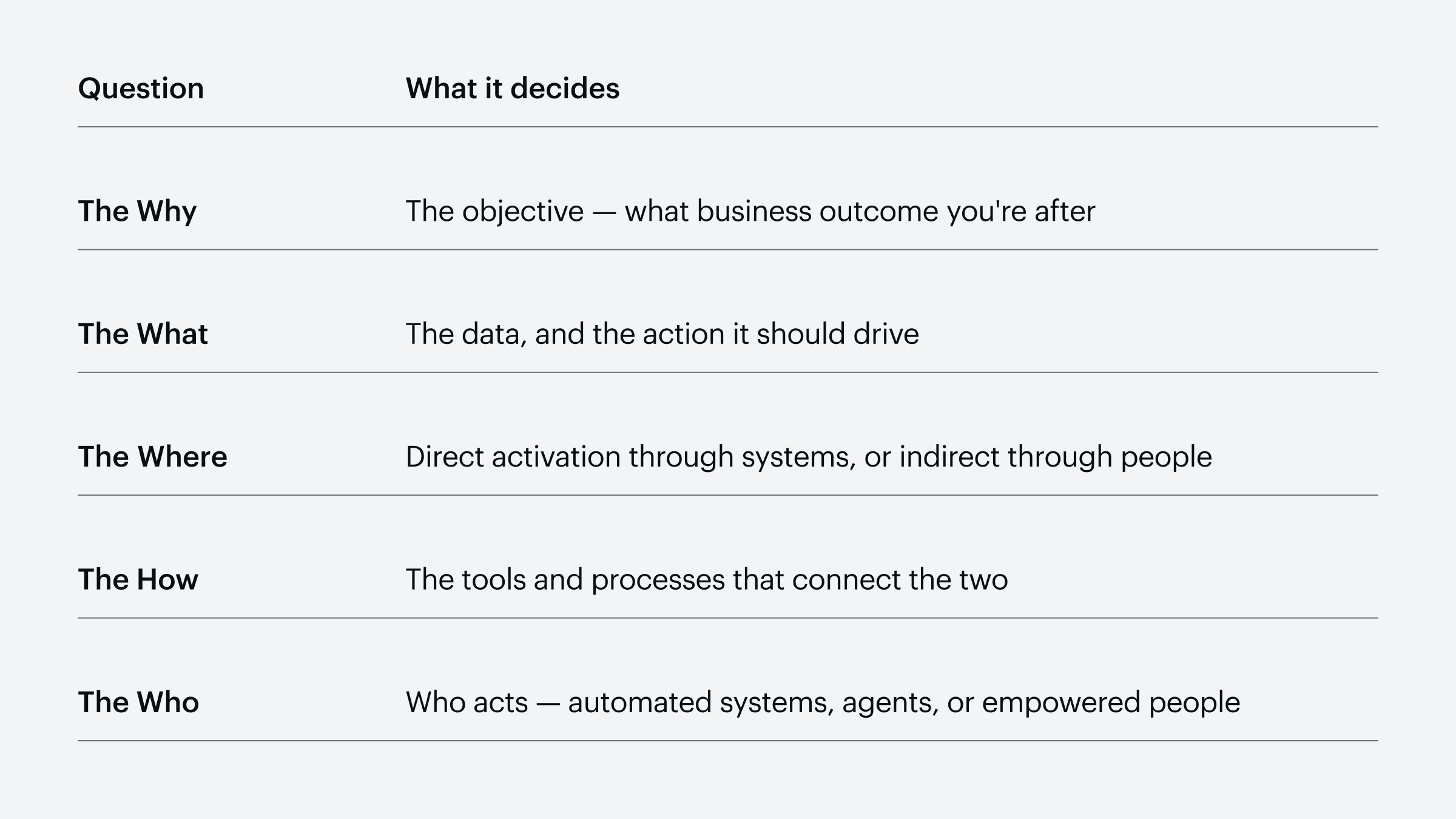
Each question turns data a little further toward action. Skip one, and the organization is activating harder instead of activating well – which is precisely how sophisticated data programs end up producing very little growth.
The framework decides direction. But there's a second piece underneath it that matters just as much: the quality of the data feeding every one of those five answers. That used to be a background concern, something for the data team to worry about while everyone else focused on strategy. It isn't background anymore. As AI takes on a growing share of the How and the Who – scoring, deciding, acting in real time, at scale – it also inherits whatever data it's given, with none of the instinct a person has to double-check a number that looks off. Good data compounds into good decisions at machine speed. Bad data compounds into confident mistakes at exactly the same speed.
The foundation the framework depends on
That's the case for treating data quality as its own strategic priority, not a detail inside someone else's project. An AI system built on messy data with no context will produce answers that sound confident and are quietly wrong – a failure mode that looks like progress until it doesn't. The lesson is blunt: quality has to come before activation, not alongside it, and it has to come before AI touches any of it.
The cost of getting this wrong is measurable. Poor data quality costs the average company $12.9 million a year, and 60% of AI initiatives never scale past pilot because the foundation underneath them isn't there. An AI-ready foundation rests on three commitments:
Quality and context – unsampled, real-time data, plus the business context that tells AI what it means.
Privacy and governance – consent-aware collection, full data lineage, and access control, so AI runs compliantly by design.
Trust and people – explainable, repeatable results, with the right people brought in early to act on them.
Get this right, and something changes beyond data quality scores. The organization's relationship to its own data starts to shift.
From gatekeeping to independence
Once the foundation holds, the more consequential shift isn't a new piece of software – it's data democratization. For years, using data meant waiting in an analyst's queue. AI removes that constraint. It connects the dots across the whole customer journey, so any team can find the real driver behind a number, not just the number itself, in seconds instead of days.
That is the actual strategic unlock: not faster dashboards, but trusted data distributed to everyone who needs to act on it, at the moment they need it. What that looks like in practice is the difference between two versions of the same ordinary Monday.
Two Mondays, one strategic choice
Run the same goal – “where's revenue going?” – through the framework, and it plays out two ways depending on whether quality and empowerment are already in place before the question gets asked.
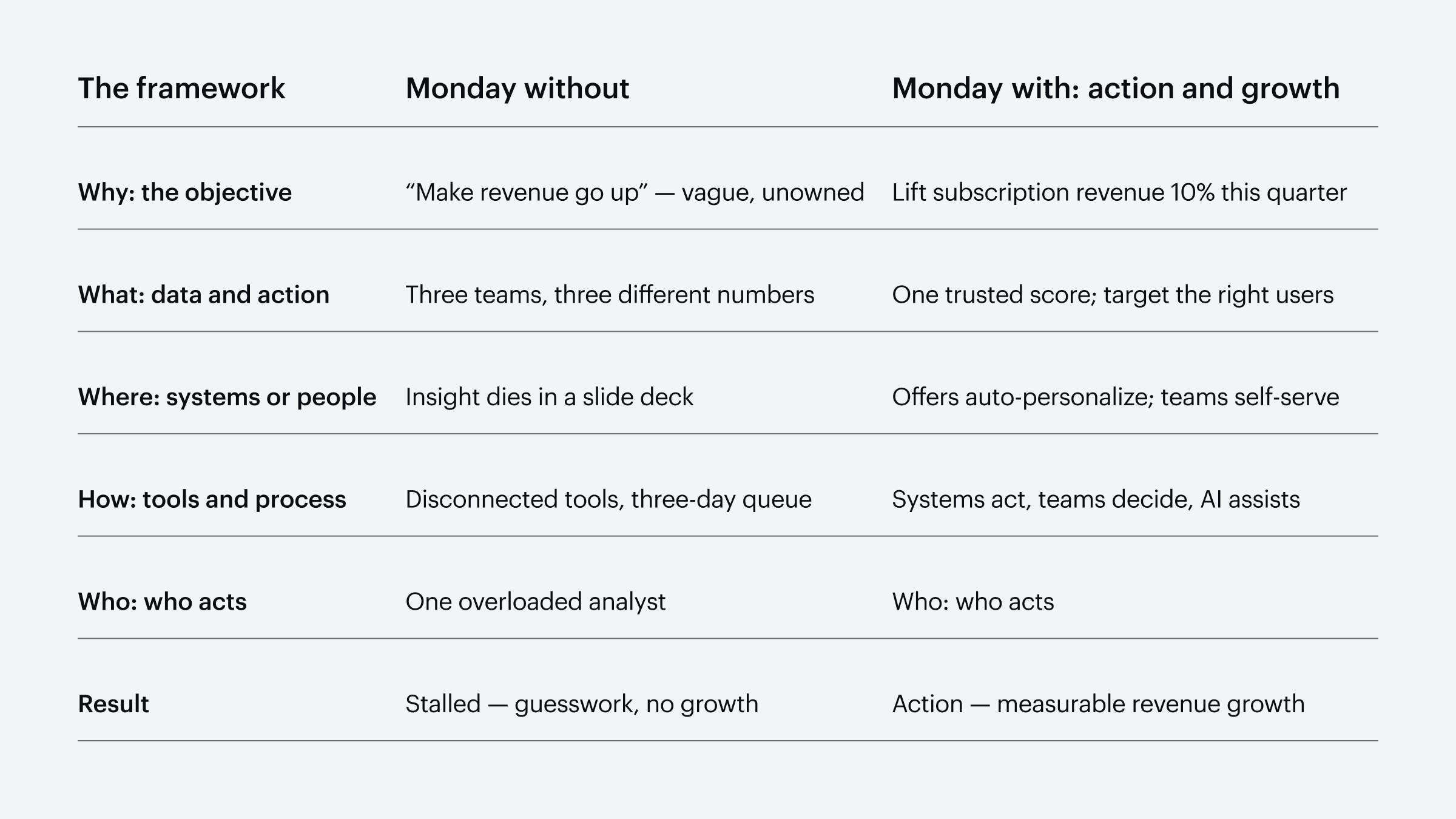
The difference isn't more data. It's whether the five questions got answered before anyone tried to act – which means the outcome on any given Monday is set well in advance, by decisions made months earlier.
Answering those questions well also forces a second, more deliberate choice: how the insight is meant to reach value in the first place.
Two routes to value — and why the choice matters
Every insight reaches value through one of two routes, and most organizations need both, in different places. Direct activation lets the system act automatically — the right user gets the right action at the right moment, with no human in the loop. Indirect activation puts trusted data in front of the people who decide. The framework doesn't prescribe one over the other. It forces the choice to be made on purpose, rather than defaulting to whichever route the last tool purchase happened to support.
That distinction isn't theoretical. It shows up clearly in how this plays out across industries that look nothing alike on the surface.
The pattern holds across industries
For The Post and Courier, direct activation runs the same loop on every pageview: signals come in, they resolve to one unified propensity score, that score picks a single action — open content, a registration wall, a soft or hard paywall, a tailored offer, or an ad density adjustment — and the result gets measured. Year over year, that loop delivered a 57% increase in ad impressions, a 57% increase in paywall revenue, a 16% increase in subscription revenue, and an 800% increase in registrations.
Indirect activation looks different but runs on the same logic. At Crédit Agricole, a customer running the mortgage calculator twice is a clear signal of intent — the kind of behavior that used to be stranded in analytics, invisible to the advisor who could actually act on it. Piano Analytics connects that signal into advisor systems and scores each customer, so an advisor reaches out based on what someone just did online. That connection now reaches nearly 12 million active mobile customers across 72,000 advisors.
Swiss Federal Railways unified tracking across websites, apps, and station displays — a complex, highly customized setup — into a single view of the traveler journey. That view surfaced rising demand from international travelers, and the team acted on it by building multilingual content to reach them before they arrive. Digital sales grew 29% a year.
Rabobank found and fixed an 80% drop-off in its car insurance form. Salomon turned a fragmented customer journey into a unified, machine learning–powered view that's accelerating its direct-to-consumer transformation. Vattenfall ran one test and saw a 16% lift in conversions, worth six figures in return.
Different sectors, different products, and the same underlying discipline: unify the data, empower the teams to act on it, and govern it for trust. That repeatability is the real signal here. It suggests this isn't a set of isolated wins, but a playbook that transfers.
Why the stakes just went up
AI is reshaping every business in the room, and it's tempting to treat that as a reason to rethink the whole approach. It isn't. AI changes the speed of the activation gap – it doesn't remove the need to cross it deliberately. If anything, it raises the cost of getting the sequence wrong, because mistakes now compound faster and reach more customers before anyone notices.
That is the strategic reframe worth sitting with: AI does not replace the judgment this framework builds. It raises the stakes on exercising that judgment well, and on doing it faster than the competition next door.
Remember these three points: start with quality – data you can trust, unsampled, in real time. Empower your people – give every team access to the same trusted data, not just the analysts. And cross the activation mile deliberately – ask the five questions before you activate and keep a human in the loop.
The organizations that treat this as a strategic sequence are the ones for whom the path from data to action keeps getting shorter – quarter over quarter, while their competitors are still buying the next tool.