
Benchmark update: Growing revenue with declining traffic

Between 2024 and 2025 roughly half of Piano’s benchmark sites lost traffic. But 80% of those sites still grew revenue. What was the difference between the sites that increased revenue and the 20% that didn’t? Which factors were most important?
We matched detailed pricing, upgrade, and churn data against overall site performance for 249 publishers to find out. There were three specific levers that separated the growers from the rest:
Pricing of new subscriptions: The sites that raised price had +18.7% median revenue growth from 2024 to 2025. This was the strongest standalone factor for growing revenue.
Pricing of existing subscriptions: Increasing price for current subscribers led to a 12% increase in median revenue growth.
Stacking tactics: Sites that used four tactics – initial price increases, current subscription price upgrades, active churn prevention (ACP), and passive churn prevention (PCP) – achieved 25.3% median revenue growth.
Pricing fundamentals
About 70% of new subscribers choose a monthly plan over an annual one. During promotional periods – often with holiday sales in November, December and January – more subscribers choose an annual plan with a big discount. That can increase the annual share by 10 points.
Most subscriptions are renewals rather than new conversions, with renewals accounting for 85 to 90% of conversions during any given month. That means increasing renewal price is an essential tactic for revenue growth over time.
General pricing strategy is consistent from market to market across the global Piano client base. Most publishers offer annual and monthly auto-renewing subscriptions, though some markets, like Germany, restrict auto-renewal to monthly terms. Annual subscriptions are frequently offered with an introductory price for the first year – usually a discount of 40-50% compared with the full annual price and the annualized monthly price. That discount creates an incentive to commit to an annual term rather than choosing a lower risk monthly subscription.
Monthly subscriptions most often have a $1/€1 for 1 month trial, or sometimes a multi-month trial priced with a similar formula, e.g. €3 for 3. Paid trials are the dominant new subscription offer tactic accounting for more than half of annual and more than 60% of monthly offers across markets. Free trials have nearly disappeared.
Raising price increases revenue without decreasing conversions
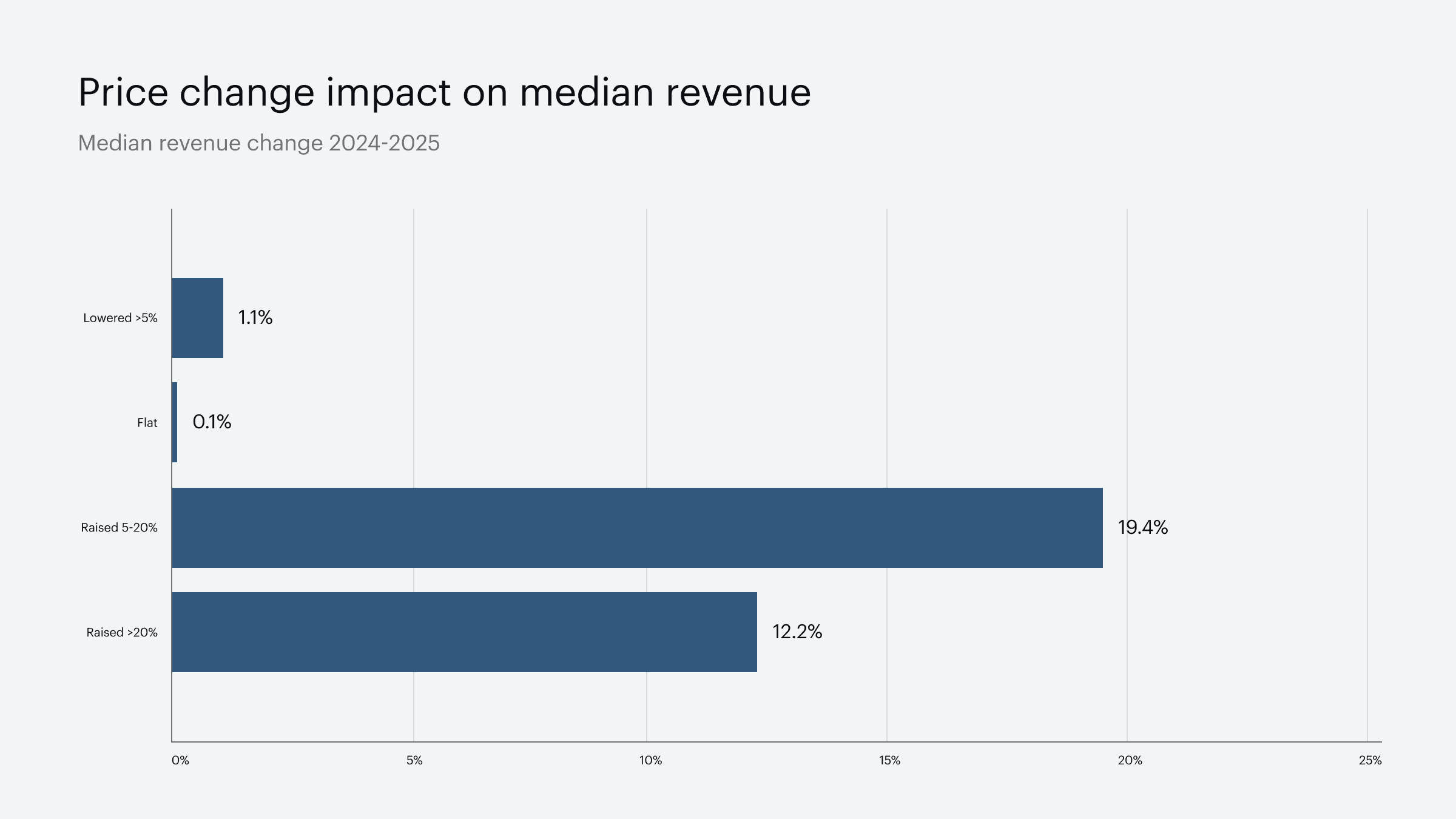
Among traffic-declining sites, publishers that raised new subscription prices by more than 5% posted dramatically stronger revenue outcomes than those that held or lowered prices. The chart below groups sites by how much they raised or lowered price and shows the median change in overall subscription revenue. There’s a very clear divide. The sites that raised prices grew revenue. Meanwhile, sites that held prices flat saw just +0.1% median revenue growth — essentially zero. And sites that lowered prices did barely better with a +1.1% median revenue increase. Lowering prices in a declining-traffic environment was not an effective strategy.
There are two obvious fears about raising price. First, doesn’t it hurt conversion rate? In our data, the answer is no. Sites that raised new subscription prices saw +5.5% median conversion growth, compared to +2.1% growth for sites that held or lowered prices. The likely explanation: publishers with strong enough products to raise prices also have stronger engagement and conversion funnels.
The second objection: Doesn’t higher pricing lead to more churn? Again, the answer is no. Raising prices doesn’t change overall churn, but there is a shift in the composition of churn. The lowest priced subscriptions skew more toward passive churn (payment failure) than the average and the highest priced subscriptions skew toward active churn (deliberate cancellation). The effect is most pronounced at the lowest and highest prices. This makes intuitive sense — subscribers paying more are more likely to be actively managing their subscriptions, so when they leave, it’s a deliberate choice rather than payment failure.
New subscription pricing and upgrades are complementary
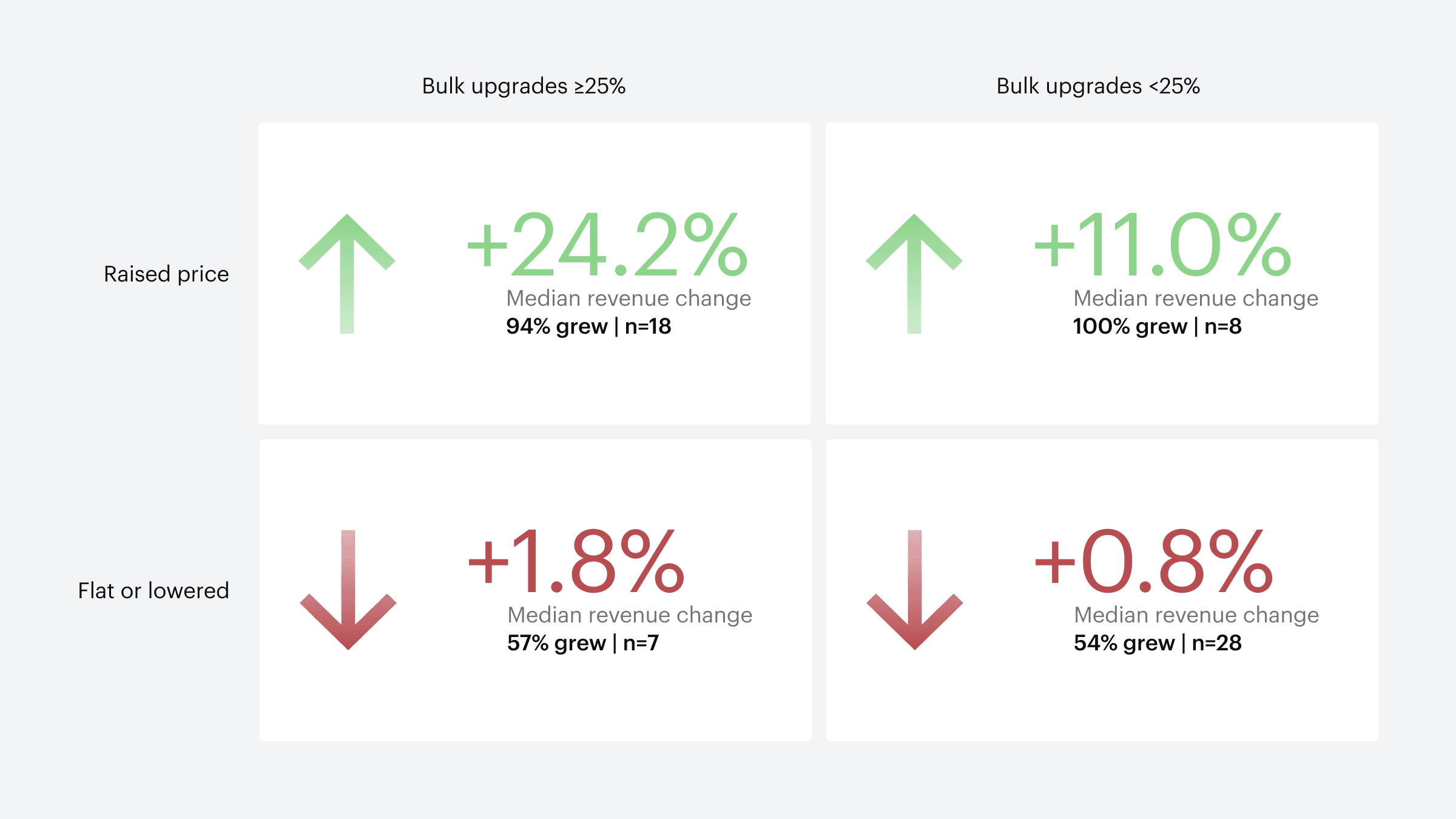
Given that 85-90% of subscription conversions are renewals, price increases for existing subscribers – “upgrades” in Piano terminology – are crucially important to revenue growth. That said, initial price has a bigger standalone effect on revenue. This grid showing results from 61 traffic-declining sites with comparable data for 2024 and 2025 helps understand the impact.
This analysis focuses on “bulk” upgrades, when a publisher uses Piano tools that enable price changes for many subscriptions at one time, for example, increasing price by $2/month for everyone currently paying $10/month. User-initiated upgrades, like opting for a higher subscription tier or switching to annual from monthly, showed no meaningful revenue relationship and low volumes.
Think of the grid as a two-by-two: did you raise your new subscription price, and did you do bulk upgrades on your existing base? The top-left quadrant is the best outcome: sites that did both posted +24.2% median revenue growth. But the more interesting comparison is the off-diagonal. Sites that raised new subscription prices but didn’t do bulk upgrades still posted +11.0% with 100% growing. Sites that did bulk upgrades but didn’t raise new prices managed only +1.8% with 57% growing. That tells us pricing is the more fundamental lever. Bulk upgrades amplify it, but without the pricing foundation, upgrades alone don’t move the needle as much.
The bottom-right quadrant is the cautionary tale: sites that did neither posted +0.8% with only 54% growing revenue. These are the publishers most exposed to the traffic decline — they’re relying entirely on volume in an environment where volume is shrinking.
A common concern about bulk upgrades is that forcing a price increase on existing subscribers will trigger cancellations. We now have the churn data to test that directly. Sites with bulk upgrades above 25% had lower churn growth of +7.3% compared to +10.2% for sites below that threshold. So not only are bulk upgrades not causing a churn spike, the sites doing them are seeing less churn growth while posting nearly double the revenue growth.
Combining features has the biggest revenue impact
Over the years we’ve seen a consistent pattern: the clients who make the most use of Piano features have the best results. That’s true in this data set as well. We analyzed the impact of number of features used on median revenue between 2024 and 2025.
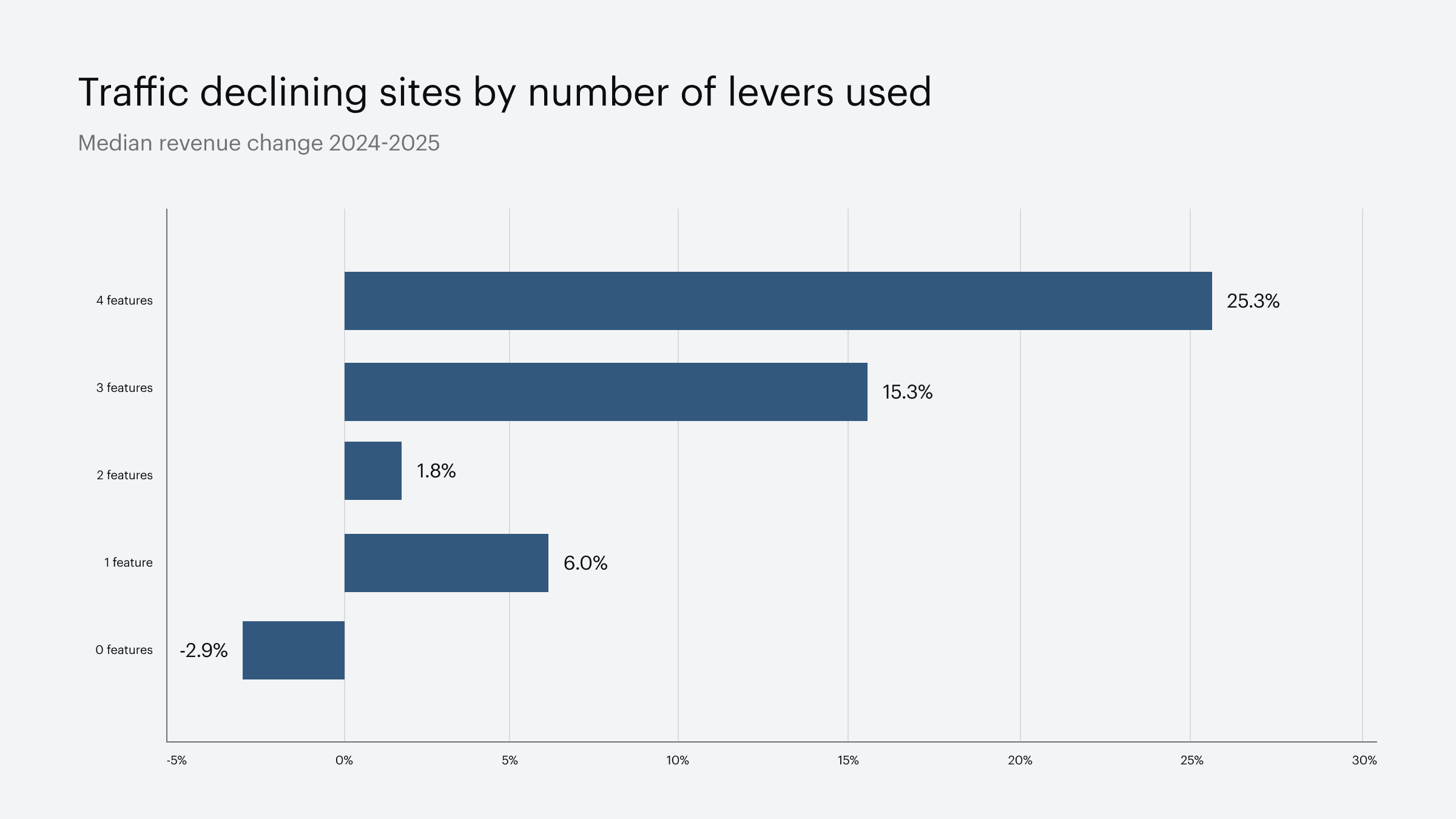
Sites using none of the four levers saw revenue decline. Sites using all four posted a 25% median revenue increase. The progression between the extremes is mostly clean – each lever adds lift with one caveat. In the two-feature group, the combination matters as much as the count. Sites that paired bulk upgrades with PCP delivered 14.2% median revenue growth. Sites that used only ACP and PCP — no pricing changes at all — posted -1.4%. That reinforces the earlier finding: pricing is the load-bearing lever. Churn prevention amplifies it but can't replace it.
Churn prevention: Necessary but not sufficient
While churn prevention features have lower impact on revenue, they are still important tactics to protect the subscription base. ACP and PCP adoption was nearly identical between revenue growers and decliners. About 45% of both groups used active churn prevention, and about 54% of both used passive churn prevention. So these features aren’t differentiators in the way that pricing and upgrades are.
That said, the churn data does show some real signals when you look at the specific churn types. Sites using passive churn prevention saw +5.1% median passive churn growth year over year, compared to +6.8% without. More telling, 42% of PCP sites saw passive churn decline, versus 30% without PCP. It doesn’t eliminate passive churn growth, but PCP appears to prevent the worst spikes.
Passive churn prevention also has a strong effect on retention over time. The sites using the feature had 44% higher growth in active subscriptions compared with sites not using PCP over three years from January 2023 to December 2025.
The ACP story is harder to read cleanly. Sites using active churn prevention have significantly higher active churn share — 75% of their churn is active, versus 58% for non-ACP sites. But that almost certainly reflects selection bias: publishers adopt ACP because they have an active churn problem, not the other way around. Active churn growth was comparable between ACP and non-ACP sites at roughly +8% year over year, which given the higher starting base might itself be a positive signal. But we can’t make a clean causal claim from this data.
Conclusions
In today’s low-audience growth era with platform traffic continuing to decline, publishers are still eager to find tactics to grow revenue. Piano’s data clearly shows the impact of increasing price for new and renewing subscriptions. But pricing alone isn’t sufficient to drive consistent growth. As last year’s Back to Basics benchmark report showed, audience engagement is the foundation for conversions and retention. The search traffic deep dive reinforced why: when platform traffic declines, the publishers who've invested in engagement depth and direct audience relationships are the ones still growing. And using tools that reduce active cancellation and payment failure churn along with price increases delivers maximum revenue growth over time.